
by Hazel Anna Rogers for this Carl Kruse Blog
In the picture on the wall, I see a man in a fitted black shirt, a satin necktie neatly knotted beneath his chin, belted leather trousers, and a stetson tilted gently over his forehead.
In the picture on the wall, I see a woman with neatly ringleted hair, shoulder-length. She is wearing a checkered short-sleeve blouse buttoned up to the neck, and a high-waisted skirt down to the knee.
In another picture on the same wall, I see a movie star, a real Hollywood girl with the name to match, dressed in a glittering dress, the fabric gathered at the waist, spaghetti-straps up from an elegant v-neck, side-parted blonde hair curled above her shoulders, red lips parted.
I see pictures from a long time ago, up on the wall in black plastic frames. I see well-dressed people at a fixed point in time, captured and frozen on black and white film.
We don’t dress like this anymore. Time has moved on. Clothes are made to buy, not to fit, thanks to the proliferation and standardisation of the ready-to-wear garment industry. While traceable back to Ancient Babylonia some 600 years ago, and practiced more notably from around the 1300s, where ready-to-wear gloves, hats, and collars were manufactured on a small scale for the marketplace, ready-to-wear did not become the fast-fashion monster it is today until the mid-20th Century, when the US saw consumer buying power increase, in part due to the rising of wages throughout the country. The art of clothes-making, practiced by most women in their homes up until the 1930s, began to dwindle as cheap, fashionable dresses became available to purchase.
The rise in popularity of ready-to-wear clothing during the mid-1900s can also be correllated with the increase in women joining the workforce. While in 1930, only 12% of married women and 50% of single women were documented as having jobs outside of the home, by 1970, 40% of married women and 50% of single women had joined the workforce. Working a job, and finally having the opportunity to pursue a career, all whilst remaining the primary caregiver and homemaker for children left little time for the making of clothes.
In 1939, the Roosevelt Administration further facilitated the mass-production of garments through a project aimed at standardising women’s clothing sizes in order to cut down on the cost of altering clothes for each body type. A select group of white women were measured, and an ‘average’ sizing chart was created. This sizing chart was then updated in 1958 when the Commercial Standard for clothing was created based on measurements acquired from low-income white women. We still feel the effects of these sizing charts today; clothing is cut and sized with only one body type in mind: a small-to-medium sized chest, small waist, and medium-sized hips – an hourglass shape, not especially tall, not big around the midriff, and not too buxom about the bosom. Thus, for the apples, pears, and straight-up-and-downs of the world, it’s become exceedingly difficult to find well-fitting clothes from common fashion retailers.
Along with advancements in fabric manufacturing, which have prioritised cheap, easily worn and broken materials (especially plastic based ones) over durable fabrics, such as wool and linen, it is no wonder that we no longer dress like the people in the pictures on the wall. The clothes we buy from fast-fashion manufacturers are clothes intended to be worn a handful of times before they wear out, and, due to the flimsy nature of the fabrics used to produce them, we are unable to repair these garments, as we would have done some forty years ago. And who has time for reparing clothes, anyway? Who still knows how to repair a skirt, to sew on a button, to fix a hole in a coat? Who would rather spend time sewing than simply falling down on the sofa after a 40 minute commute from an 8 hour job, remote in hand, Netflix on the screen?
And, so the clothes go in the bin, and we buy more.
The consumer can’t really be blamed for all of this. Exponential inflation throughout the Western world has made it necessary for many of us to work ever more hours, and even pick up second or third jobs to pay rising rent and bill prices. Time outside work is being squeezed to the last drop. Cooking, making or repairing clothes, spending time with family…all of these previously commonplace ways of life are dropping away from us. We’re too tired. We’re too worn out. The theatre is too expensive. Going out for two coffees could set you back £10 in London. Going to a chain cinema could leave you with a £40 bill on your hands. So we retreat home, we retreat to our computers, to online shopping, to buying things to make us feel good, if only for a moment. A new dress, a new pair of shoes to wear to a party next month, doesn’t matter if they don’t fit right, you can send them back, or throw them away after you’ve worn them, they were cheap enough that it doesn’t matter, and at least you were on-trend, at least you looked good, if only for a night. Trends come and go within weeks, even days, the next best thing is just moments away, and you can buy it with your hard-earned money. In fact, you’ll be encouraged to do so, through ads on your phone, ads on the bus-stops, ads on the sides of buses, ads in the newspaper, ads in the tube, ads on the train. It’s relentless, and the clothes we end up buying are cheap, cheap renditions of styles and patterns from decades ago, except this time round they don’t look so good, and because we all saw the same ad, we’ve all bought the same one.
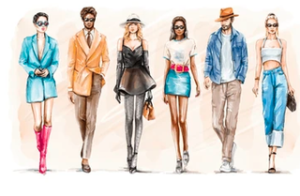
Dressing well is an art. And it used to be non-negotiable. In 18th Century England, the labouring classes used clothing as a means of retaining respectability, despite their social ranking. Most people would own at least two full outfits, the second generally being in better condition as it was used for Sundays, holidays, and leisure as opposed to farm work. Working class people often had few possessions aside from clothes, and they saved up their wages in order to purchase clothing and fabrics to appear respectable and fashionable, and, hopefully, to increase their chances of social mobility. A well-dressed country girl could very well catch the eye of a wealthier landowner; should she manage to marry such a man, then her whole family would benefit, financially and socially. A poorly dressed woman, or one who acted or dressed immodestly, could disgrace her family so far as to lead to her siblings to no longer be able to find husbands.
Dressing well, and acting the part, was a vital way of life, and it continued to be up until around the 1950s. Of course, fashions changed, but the daily task of looking presentable and put-together remained. During the wartime decades, women joined the workforce in their thousands, leading to a stark shift from the looser, more androgynous ‘garçonne’ or flapper trend of the 1920s to utilitarian, military-inspired clothing (partly influenced also by the rationing of fabrics), then the Hollywood Starlet was born, and she was born with a 19-inch waist, a pointed brassiere, and a full-skirted silhouette to boot; traditional femininity, having taken a punch during the two World Wars, was back. In her book Icons of Fashion: The 20th Century, Gerda Buxbaum writes: “The long years of deprivation during World War II brought forth a yearning for luxury and fashionable things, and women made a special effort to dress appropriately for every occasion; it was considered imperative that one’s accessories matched perfectly” (69).
Fashion, and clothing purchasing habits, changed rapidly throughout the 20th Century. The advent of the ‘teenager’, which became a distinct social category from around the 1950s, had an especially sharp impact on clothing from the decade onwards. Thanks to mandatory schooling, which took children and teenagers away from the factories and farms that their parents worked at, the young population were enabled to discover and create their own collective culture and experiences. The economic boom of the 1950s lead to higher wages and rates of employment, but also lower rates of childbirth – parents would focus their time and income into raising fewer children, leading to an uptake in leisure activities by teenagers such as sports and summer camps, but also to greater spending power; teenagers would go out dancing, go out to the movies, and spend their money on clothing, records, and food, which resulted in a marked shift by companies, who began to target this up-and-coming, and highly influencable, spending demographic.
Teenagers rebelled against the status-quo, against the dated fashion of their parents, and their dated attitudes. Girls wore traditional men’s clothing, boys experimented with colour and hairstyles. And from the late 1950s into the 1960s, things changed ever more drastically thanks to the growing popularity of music, notably Rock and Roll. Onwards we go, and Bowie bounced onto the world stage in his women’s clothes, his make-up, his New Romantic ruffles; Patti Smith came out of the woodwork, emaciated, black-smudged eyes, braless, in a white t-shirt and jeans; out ran Grace Jones with her sharply-cut afro and her even more sharply-cut men’s blazer; hippies in their paisley patterns and mini dresses; mods with their helmet haircuts and pops of colour; punks with their leather and their ripped jeans and their mohawks; and so on, and so forth. Fashion developed at breakneck speed, sped on by teenagers, by their desire to rebel, their desire for social change, their desire to become individuals distinct from their family unit.
Time has moved on.
The ‘rebellion’ of fashion choices has slowly begun to lose its impact, with the proliferation of niche or alternative fashion choices over social media, and the harnessing of subcultures by fast-fashion clothing brands and online retailers. Punk clothing is not longer homemade – safety pins holding up the sleeves of shredded up t-shirts, jeans sliced up with scissors and knives, lace sewn onto skirts – because we can buy it, ready made, from our favourite clothing stores. We are no longer shocked by people’s clothing, because we’ve seen it all before. In the late 1900s, the outlandish fashion choices of the young reflected their rejection of the ‘old world’ of their parents, and particularly the ‘traditional’ values they upheld, such as homophobic and racist beliefs and stringent gender roles.
Individualism was defiant in 1960s, because Western society had been defined for centuries by long-upheld family values. Rejecting these values risked becoming an outcast from one’s family and community. That isn’t to say that, today, there are no risks associated with identifying oneself with marginalised communities and subcultues; the trans and gay communities still face prosecution and rejection from their family groups as a result of their standing apart from the patriarchal nuclear family. People of non-white origin still face discrimination if they wear their natural hair, wear traditional clothing, or engage in their respective cultures before a white audience. In most places in the Western world, it is still not acceptable for a man to wear a skirt, or otherwise traditionally feminine clothing, without facing harassment.
But things are different, now. Individualism is no longer a politically rebellious act; it is the social norm. We want to be ‘different’. We want to be remarkable in a sea of faces and bodies. And clothing companies are well aware of this. The emergence of ‘micro-trends’ – specific niche fashion trends that have a short lifespan, sometimes only a week or two – and the immediate monetisation of these trends by big brands is proof that subculture is at an end.
The distinction between the fashion of the wealthy and the working classes has narrowed, too; particularly in the white middle class left-wing elite, it is not socially acceptable to dress in a manner that indicates one’s class or wealth status. We have ended up with white-collar people dressing in worksman’s slacks, beanie hats, and work jackets, which has resulted in the gentrification of clothing previously worn by blue-collar workers: Carhartt, Barbour, Caterpillar, Dickies – a pair of work trousers from these companies will now set you back a decent pocketful of cash. But at least you don’t look like your dad in his white shirt and tie; it’s cool to look poor in the 21st Century, as long as you still smell like Gucci perfume, as long as you’ve just finished reading a book by Bell Hooks.
Respectability, in terms of clothing choices, in now an imposition placed solely on the labouring classes, who are tasked with looking smart and put-together in order to avoid discrimination. It’s alright for a white, middle-class, London-born guy to wear a hole-covered t-shirt and a paint-stained jacket to work; if a working class man of colour wears the same thing, he’s risking his job security. And then there’s the fast-fashion side of it all; cheap, quickly manufactured clothes that fit current trends. It is not the poorer population that is buying up £1000 hauls of these clothing items, it is the wealthy, often with the intent of flaunting their extension clothing collections online, thus instigating similar buying habits in their dutiful followers. Affordability has little bearing on the purchasing habits of different populations; working class people are more likely to retain their clothing for longer, and to rely on hand-me-down or second-hand clothing, which can mean clothing that is made of more durable materials, particularly if clothes are passed down through generations of family.
But what does all this mean? And what does it have to do with the pictures on the wall, of the well-dressed people in the photographs? What does it have to do with the ‘art of dressing well’?
Today, rebellion in fashion means dressing well with what is hung in the wardrobe in the corner of one’s bedroom. It is a refusal to engage with microcosmic trends. It is a decision to dress in a shirt and suit trousers when your higher-earning peers are dressed in Carhartt trousers and traditional Apache moccasins. It is the decision to buy only second-hand. It is a decision to buy less, and take care of the clothes you have.
There is another facet to all this, and it’s wholly my own opinion. I wrote an article some time ago about the death of the celebrity interview, and in it, I quote French actress Sophie Marceau. She speaks of a Hollywood of old, of people dressed to the nines, of real honest stardom, of LA dreams, and then of the transition to actors dressed in jeans, and the loss of the movie starlet and stud.
What Marceau is referring to is the art of dressing well; it’s what we see in our grandmothers, who dress elegantly simply as a rule. It is the image of my own grandmother, who was raised in Morocco, opening the door to my boyfriend and I at 11 at night wearing an old silk nightgown and babouche slippers. It is a decorum, a respectability, a pride that we lack now. You see it when you watch old films. A man in a hat. Robert Earl Jones and Robert Redford in the 1973 movie, ‘The Sting’, dressed in three-piece-suits despite being essentially down-and-out pick-pockets. It is the pride in polishing your shoes, in sewing up a hole in the armpit of a jacket you’ve had for 15 years, in wearing the same clothes you’ve worn for the past decade or so because they look good, and they suit you, and you have no need for anything more. It is a timelessness, not any particular style, but more an inner, personal style that feels honest and true. It is an art to dress well, but it is an art that ultimately comes from within.
========================
This Carl Kruse Blog homepage is at https://carlkruse.at
Contact: carl AT carlkruse DOT com
Other articles by Hazel include My Eye, The Death of Analogue, the New Journalists, and the Olivetti Typewriter.
Also find Carl Kruse on Fstoppers.
