
by Fraser Hibbitt for this Carl Kruse Blog
Here we see, in a bamboo-walled room, actors preparing for a scene: two men have minor prosthetics, making their faces seem bloody, bruised, and lacerated, another larger man is dressed in drag, a few more sit at a table. A plain dressed man addresses them, ingratiatingly, promises not to be criticizing the film, but would like them to consider an additional scene. Thus, he tells of the time how his stepfather was murdered in the early hours and left for his grandfather and he to find in the morning, under an oil drum. He speaks, with brio and animation, laughing like some warm memory, how they ‘buried him like a goat next to the main road’. Again, smiling, this is no criticism of the film. The response from the actors is lukewarm and they pass it off as too complicated to film.
This is a vignette from Joshua Oppenheimer’s The Act of Killing (2012). However, you could choose freely a timestamp and be astounded by the casual air of murder. A document of the Indonesian mass killings of 1965-66, as told and re-enacted by those who perpetrated the killings. Perhaps it is the most concrete way of speaking about mass murder barring watching the actual brutality. Even then, consider actual brutality: it has an altogether unreal quality, an incomprehensibility, and a horrible fascination and excitement that elevates it out of the ‘real’. In The Act of Killing, we see a group of men, most notably Anwar Congo (d. 2019), recreating scenes of torture from their personal past, only it is often highly stylised. They dress up as Al Capone gangsters; they meet the ghosts of the communists who thank them for setting them free. Oppenheimer has little bearing in any of the scenes, only occasionally is an unseen Joshua addressed, or does a quiet voice ask a question. The killers are happy to have the camera’s attention, happy to own history. You can understand now why they did not care to incorporate the tale of stepfather. It is not of their own making.
Oppenheimer described it as ‘wandering into Germany 40 years after the holocaust only to find the Nazis still in power’, and it certainly took its toll. Shot over 6 years from 2005 to 2011, Oppenheimer frequently flew back to London to recover from exhaustion, insomnia, and psychic sicknesses incurred following and filming Congo’s death squad. It is rare, if not unique, to follow such men and Congo is the focus. Close to the start, he tells us how he tried to forget: a little drink, a little marijuana, a little ecstasy… to dance, sing, be happy… and, seeing him, a slender dandy, amenable, warm, demonstrate his less bloody way of murder by use of a wire, is a moral fugue.
The act of killing means for the killer ultimate victory which is sufficient to say: I am absolutely correct. Adi Zulkadry, fellow executioner, when asked whether he would be afraid of taken to The Hague and tried for war crimes, scoffs. All is relative, this morality of today is not the morality of tomorrow: the Geneva convention? Ah soon there’ll be a Jakarta convention. Besides, too much time has passed since then. When we first meet Zulkadry, he is wearing a black shirt with the word Apathetic in large yellow print. The politicised killer works under the aegis of necessity and the necessary is neither good nor evil; it is necessary. It is like fate. Zulkadry feels no guilt, no remorse, like an ideal stoic, able wholly to align his emotional life with this necessary fate. During a run-through of a scene, Zulkadry points out that all these re-enactments seem to show them as cruel, not the communists; it is we who were cruel and sadistic. Nobody on set has any objections to this, in fact, it is met with a silence like the unspoken rules of the game have been given up, or in their enthusiasm to be on film they forgot what the content was. It is only Zulkadry to notice because ideologically speaking he is the most robust and dogmatic to the cause. Why would an executioner such as Zulkadry make the point? Is there something ideologically threatening in portraying events as they were? During a take not shown in the documentary, Zulkadry alleged Oppenheimer was a Communist and asked for production to stop filming. Despite his views, it is at these points Zulkadry seems to be the mentally weakest of them all. It is difficult to know how anyone else feels, considering how with zest they work to recreate the torture and brag to the camera. It is only with Congo we see an internal conflict, a terror born by a history of radical violence.
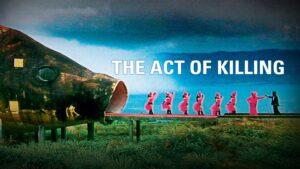
As we progress through the fantasies of these men, the withdrawn complex of Congo appears and reappears. The dailies of the filming were quickly dispatched so that the actors could review the material, and so we watch as Congo watches himself, only now it is not Congo; it is Congo elevated: as the gangster he has seen in so many movies, as a victim, and it comes to the fore with his final scene of blessing, the dubbed ‘fever dream’ of redemption: to my eyes, Congo’s least believable performance. Through the length of this document, Congo becomes more often shocked by himself, taken aback by the events which, until then, had only lived on, as he tell us, as nightmares – or as Zulkadry explains to him: that is only a nerve issue, go to a doctor and they will right it. Without this coldness, habitual violence on this scale is a rupture of conscience. It is true, it may be a necessary rupture to defend a way of life, but it is ruptured no less. The final scene, which the recent film The Zone of Interest nods its head to, is a culmination of sickness. In the silence of a non-descript rooftop, used many years ago for the destruction of so many human lives, Congo viscerally gags, stumbles, and spits. He gags again and again; his body wavering. From the distance of a garage room, we see him leave out of a door and stumble into the night like flotsam.
Oppenheimer followed but one death squad and created a document of their imagination. There is little context given of the situation in Indonesia during this period. We know Congo was a street gangster, that he sold blackmarket cinema tickets, primarily of the American films he loved: noirs and gangster films. The Indonesian communists wanted a ban on American movies. This is stated without the ridiculous conclusion that such violence should necessarily follow from this ideological clash, but it did, and here we are on the street which has no abstract ideological argument. There is a clip in the film of a speech given by then Vice President of Indonesia Jusuf Kalla where he praises gangsters (the word originates, as we are told several times throughout the documentary, from ‘free men’). A free man gets things done. If everyone worked for the government, we would have a nation of bureaucrats. Power here is power everywhere, far removed from the slaughterhouse.
As the Voltaire quote at the start of the film states: ‘It is forbidden to kill; therefore all murders are punished unless they kill in large numbers and to the sounds of trumpets’. As history goes, no crime of genocide took place in Indonesia between the years 1965-66. There were violations of human rights, no doubt, but history repeats it necessary refrain: nothing inhuman happened.
This Carl Kruse Blog Homepage is at https://carlkruse.at
Contact: carl AT carl kruse DOT com
Other articles by Fraser include On My Failure To Write Anything About The Music I Hear, Magical Thinking, and Oliver Sacks.
The original Carl Kruse blog is at https://www.carlkruse.com
