
by Hazel Anna Rogers for this Carl Kruse Blog
I’d taken the train to go and see my friend, Cathy Wippell, perform her solo show, a cabaret set in London after the apocalypse. It was good. I laughed a lot. Cathy’s a talent.
Afterwards, I sat with Cathy and Joseph Archer, her partner, in the pub where she’d performed. The night was all big loud boozing. I hadn’t been back long from shooting out in Bulgaria for Lucky Strike (dir. Rod Lurie, 2026), and I still felt the glow rush of CAMERA, ROLLING, ACTION.
Joseph started talking to me about a project, a found-footage film set during the year of the Jack the Ripper murders, 1888, and filmed using an old pinhole camera. He asked me who I’d have been, back then, in Victorian London. I said a prostitute. A prostitute called Fanny.
Then I was back, back home, Christmastime swinging round, fast and furious, summertime lost in mud-boots and crisp mornings. Just a few nights after Christmas Day, we had a Zoom call, all of us, all the cast with Joseph and Cathy, and we read through the script, the script that Cathy had written, and it wasn’t real, not yet, it was just a script, just a script and a group of people hundreds of miles apart, pixel smiles and crackling enthusiasm coming through the speakers of my father’s laptop. Is this how film always happens? A dream shared, drunken fantasy, quiet belief, belief can take you anywhere, you just gotta give it time.
A couple weeks later, and I had arrived on set for the first time. Strapped into my corset, ribs crunched flat, hair teased, girls I’d never met before sitting in the old kitchen. It was my birthday, that first day, but I didn’t tell them.
Short days, January stillness, where the branches cradle the low sun. Dip, flatten, night comes around, and we’re still in that kitchen, and I’m wrapped in a puffed-up coat like a downy chick, and we’re all shivering, and we know each other better, now, me and these girls, we’re laughing and our breath makes brittle white cloud. They call me out for my scenes, into the night, my breast is bare and my lips are painted pink-red.
I am not cold when we start filming. We film with the others first, boys dressed as policemen. Then it is just me and Joseph and the camera, and it is quiet, and the insects have all gone underground, and we make magic together.
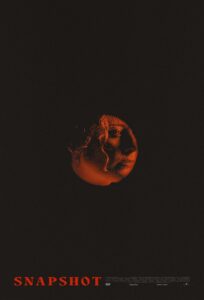
This film was many moments of magic. You see the screen in the cinema, high up wide, and it is difficult to understand that these pictures are made of early mornings, late nights, stubborn hearts and diamond minutes. It is difficult, even, to believe that it got made at all, that, before me, on a wide-open screen at Edinburgh International Film Festival, the film that I made with my good sweet friends Catharine Wippell and Joseph Archer, is real. I think of all the scripts on my computer, or the notes written here and there inside wrinkled notebooks and on scraps of paper, all the films I dream of, I dream in film, and they are all as yet unmade, they are all sleeping inside my head because I haven’t the courage, I haven’t the strength to do it. But there, in that blackened-brick city, where the mountains crown the horizon, we sat, all of us, all the girls of the film, and we held hands as the film, the film we made together in ramshackle houses and cold stone kitchens, stuttered into view, sepia world, crack-bite-slam of the camera, this is too wonderful, my eyes are blurring, I’m crying, we did it.
And it is a marvellous film. Cut-throat cuts, scenes jammed together like a merry-go-round, Victorian dresses flouncing over cobbles; it’s an onslaught of laughter curdling with terror seeping into nightmare sequences that flash and thunder over your eyes so quickly that your mouth goes dry. I like myself in it, but I am the least of it. This is a true ensemble film, a narrative that follows the women of the All Ladies Ghost Hunting Society – Minnie, Fanny, Molly, and Evelyn – who seek to prove, through the use of a pinhole camera manipulated by an unseen videographer called ‘Tamworth’, that Jack The Ripper is in fact a spirit, a phantom, a monster, and not the human man whom the police have thus far failed to capture. What ensues is a journey into the pit of Victorian London, found-footage style, where tabloid-esque misinformation runs rampant through the likes of newspapers such as The Illustrated London News (a worthy contender with some of the misinformed newspapers we read today). We find ourselves frequenting seedy brothels, dreaming feverishly in opium dens, and pushing through the hubbub of East London, where crowds gather to see the spots where women were found disemboweled, mutilated, by The Ripper.
I did not see the half of it, you know. The making of the film, and all the hours that Cathy and Joseph spent getting this thing on the big screen. Low-budget filmmaking is a violent craft; emails, meetings, phone calls, you’ve got to sell it, you’ve got to get them interested, why should they care about your film when the world is burning? Why should they care about your film when they don’t know who the hell you are?
That’s the biggest art. Making the money-mouths care about a couple of nobodies making a movie for a pittance. The creation of a film is only a quarter of the struggle; the last three-quarters are tears in corridors because you haven’t slept good in seven weeks, or quiet celebration in an alleyway pub because a man told you he liked what you did, and he has the money to back it up. Independent filmmaking is all promises, some broken, others fulfilled, and you never know. You never know. I saw that in Cathy’s eyes at Edinburgh, tired eyes made of computer screens, she cut out her heart for this film, all for love, and I think that’s magnificent. They’re an unstoppable pairing, she and Joseph.
I met them one afternoon in a coffee shop near Central London, about three years ago. It was sunny, and I did not have an acting agent, and I was profoundly depressed. I found their website from a link in a group chat I was in, and I emailed them and we met up. I drank tea, and I was nervous, but they were not so scary, and we got on well. An hour from my day, that afternoon of our first meeting, turned all of a sudden into these sweet days, walking into the Odeon in Leicester Square, photographers flash-white-click, and I feel sick to my stomach, all these people, but it’s the dream, the dream became real, did you ever think it could? These tiny decisions, these starting steps. I couldn’t have imagined all of this. These two people, taking a chance on me, on all of this, blood and trains and aeroplanes. It is quite remarkable. I am inspired, even in these slow days, when I have lost (yet another) job – I am inspired by the fact that it can happen, that it has happened, that it will happen again. Life is strange, and movies are magic.
=================
This Carl Kruse blog homepage is at https://carlkruse.at
Contact: carl AT carlkruse DOT com
Other articles by Hazel include Film Posters – A Dialogue With History, the Death of Analogue, and a Review of the Documentary “The Act of Killing” and a Love Letter to Doctor Who.
